Why AI Feels Difficult at First
AI tools like ChatGPT and Claude are powerful, but they aren't mind readers. They respond to what you type — nothing more, nothing less. When beginners get weak results, it's rarely the tool's fault. It's usually a small mistake in how the tool is being used.
The good news is that every one of these mistakes is easy to fix once you know what to look for.
Mistake #1: Expecting Perfect Answers
AI is not an oracle. It's a probability engine that generates the most likely next words based on your prompt. That means it can be confidently wrong — a behavior called hallucination.
Beginners often assume the first response is the final answer. In reality, the first draft is a starting point, not the finished product.
Mistake #2: Writing Weak Prompts
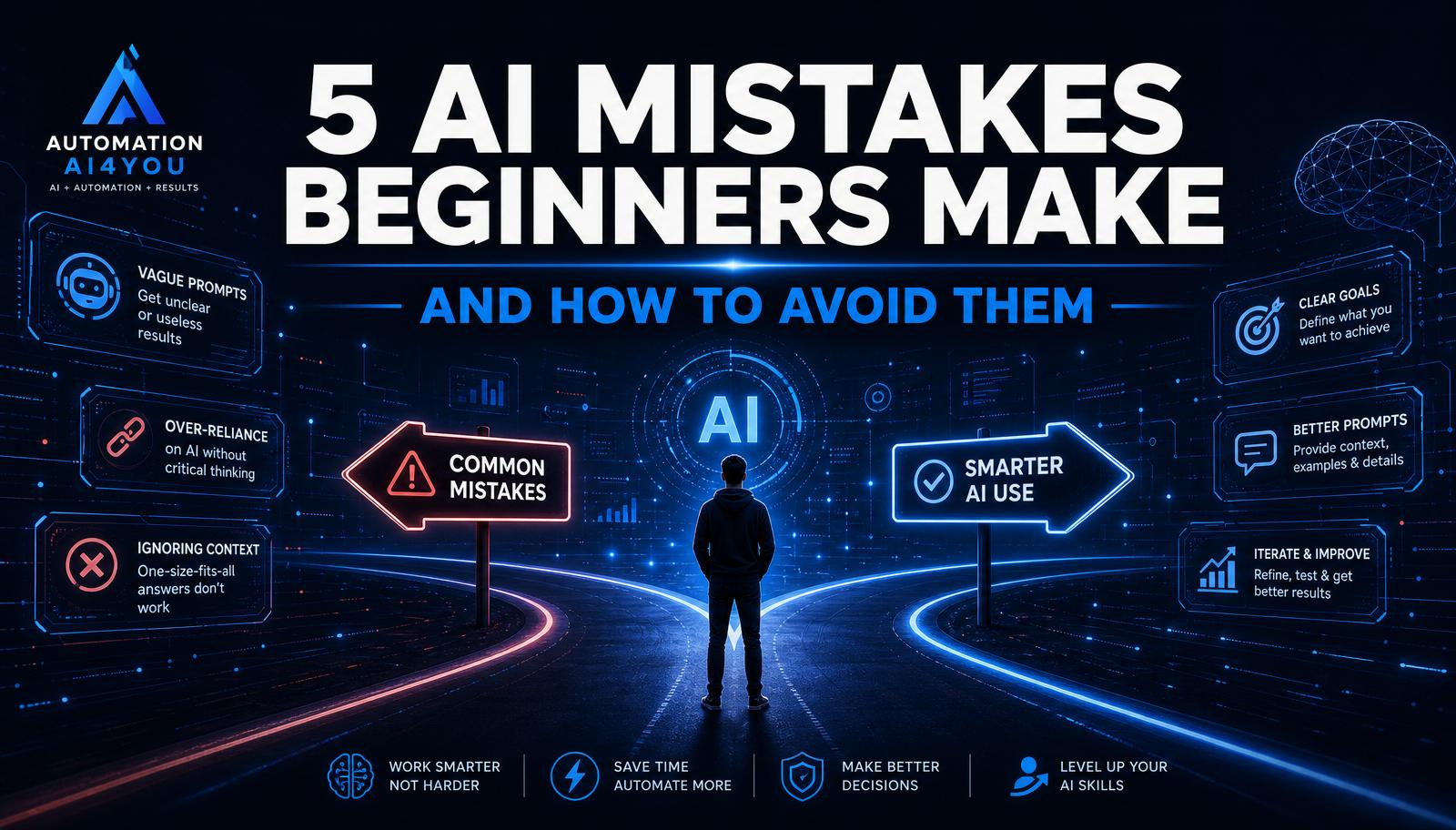
The single biggest reason beginners get bad AI results is weak prompts. A vague prompt like 'write me a blog post' gives the AI almost nothing to work with — so it produces something generic.
Strong prompts include four things: a role, a task, context, and a format. The more specific you are, the better your output will be.
Mistake #3: Skipping Fact-Checking
AI can produce information that sounds accurate but isn't. Statistics, dates, quotes, and citations should always be verified before you use them publicly.
This is especially important if you're building an audience or a business. One inaccurate claim can damage your credibility fast.
Mistake #4: Using Too Many AI Tools
New AI tools launch every week, and beginners often try to use all of them at once. The result is confusion, wasted subscriptions, and no real mastery of any tool.
You'll get far more value from mastering three tools deeply than from dabbling in twenty. Pick a small stack and stick with it long enough to become fluent.
Mistake #5: Letting AI Replace Critical Thinking
AI is a thinking partner — not a replacement for your own judgment. When beginners paste AI output without reading it, editing it, or questioning it, the quality of their work drops.
Use AI to speed up your work, but keep your brain in the loop. Your voice, taste, and critical thinking are what make the final result valuable.
Best Practices for Better AI Results
A few simple habits will dramatically improve everything you do with AI: write specific prompts, give the AI examples of what you want, iterate instead of accepting the first response, and always review the output before publishing it.
Do these four things consistently and you'll be ahead of 90% of AI users.
Knowledge Check
Before moving on, make sure you can answer these:
• Why should you verify AI-generated information? • What makes a prompt effective? • Why is using too many AI tools a problem? • How can AI improve your productivity without replacing your thinking?
Action Challenge
Pick one weak prompt you've used recently and rewrite it as a detailed prompt — include a role, a clear task, context, and a specific format. Run both versions in ChatGPT and compare the responses side by side.
You'll see the difference immediately, and the habit will stick.