
What Is a Sales Funnel?
A sales funnel is a series of intentional steps that move a stranger from first-time visitor to email subscriber to buyer. It's called a funnel because more people enter at the top than reach the bottom — that's normal and expected.
Instead of hoping visitors magically buy something, a funnel gives each person a small, logical next step: read this article, download this free guide, open this welcome email, click this recommended tool. Each step builds a little more trust.
Why Every Online Business Uses Funnels
Most visitors are not ready to buy the first time they meet you. They're curious, comparing options, and figuring out whether they can trust you. If your only call-to-action is 'buy now,' you lose almost everyone.
A funnel solves that. It lets you help people at every stage — beginners who need education, considerers who need proof, and buyers who need a clear recommendation. That's why every serious online business, from solo creators to billion-dollar SaaS companies, uses one.
The Four Stages of a Funnel
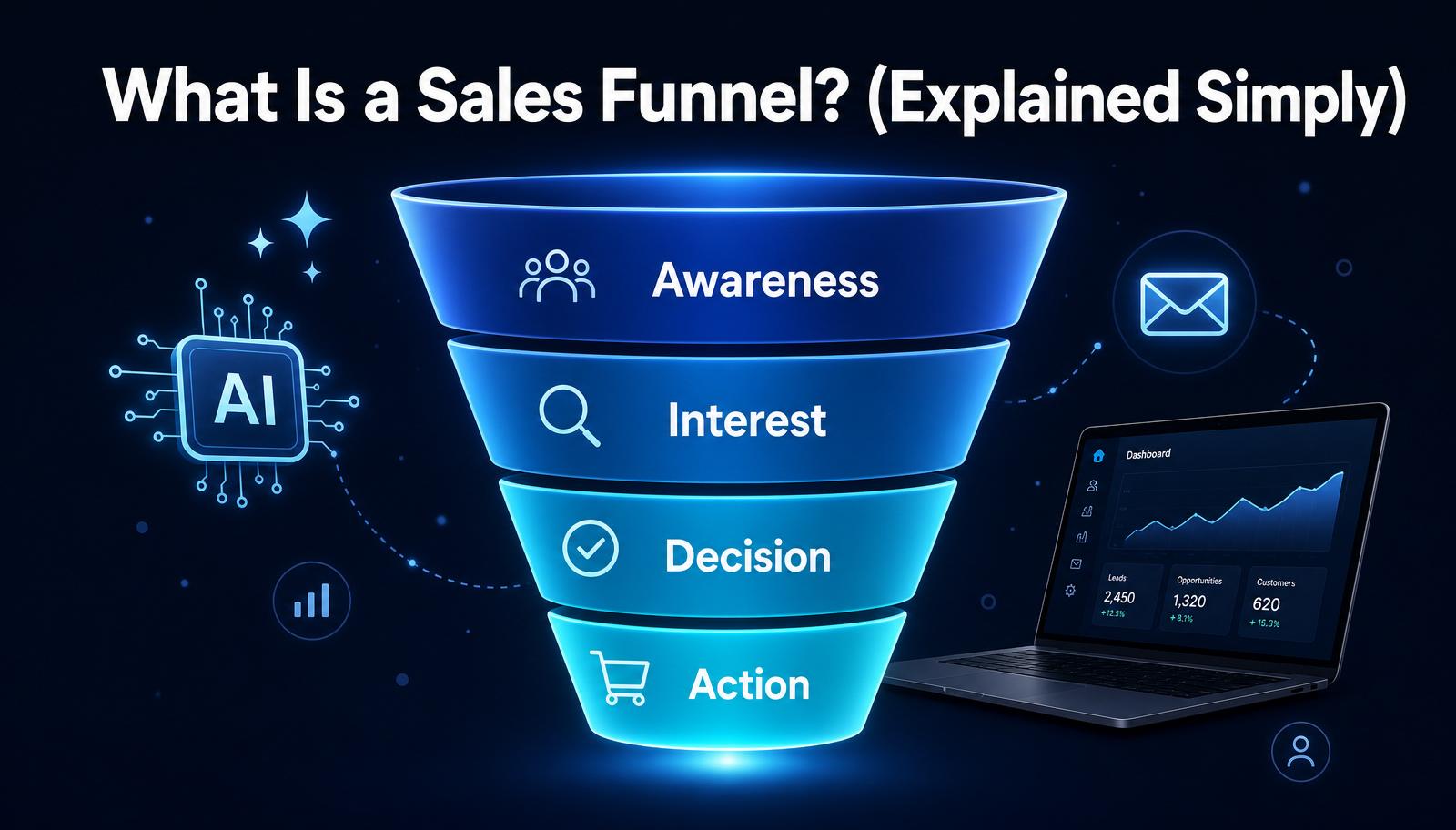
Every funnel — no matter the industry — has the same four stages:
1) Awareness — someone discovers your content through search, social media, or a referral. 2) Interest — they read more, follow you, or explore related pages. 3) Decision — they weigh options, compare products, and read reviews. 4) Action — they take the next step: subscribe, download, or purchase.
Your job as a beginner is to build one small, helpful step for each stage.
Example: An Affiliate Marketing Funnel
Here's what a simple beginner affiliate funnel looks like in real life:
A reader finds your blog post 'The Best AI Tools for Beginners' on Google (Awareness). At the end of the article they see a free download — the AI Affiliate Business Starter Kit — and enter their email to get it (Interest). Over the next several days, an automated email sequence teaches them how AI and affiliate marketing fit together (Decision). One of those emails recommends a specific tool with your affiliate link (Action).
That's the entire model. One helpful article, one free lead magnet, one welcome email sequence, one honest recommendation — repeated consistently.
How Email Fits into the Funnel
Email is the connective tissue of every good funnel. Social platforms show your posts to a fraction of your audience, but email lands directly in someone's inbox — where you fully own the relationship.
Inside the funnel, email is where trust is built. Each message educates the subscriber, answers common objections, and gradually introduces the offers you recommend. Without email, most visitors leave and never come back.
Why Funnels Build Trust
Trust isn't earned with a single sales page. It's earned through small, consistent moments of helpfulness — a useful article, a valuable free download, a well-written welcome email, a recommendation that actually solves the reader's problem.
A funnel is really just a system for delivering those helpful moments in the right order. When trust goes up, conversions go up — automatically.
Common Beginner Funnel Mistakes
The biggest mistake beginners make is skipping the middle of the funnel. They send visitors straight from a blog post to an affiliate link and wonder why nothing converts.
Other frequent mistakes: making the funnel too complicated with 10 emails and 3 upsells before you've validated anything; ignoring the email list entirely; and promoting products they haven't personally used.
Knowledge Check
Before moving on, make sure you can answer these:
• What are the four stages of a sales funnel? • Why do businesses use funnels instead of sending everyone directly to a sales page? • Where does email marketing fit into a funnel? • Why does trust improve conversion rates?
Action Challenge
Sketch your own funnel on one page. Write the four stages down the left side and, next to each, write the single step a visitor would take at that stage in your business. Identify one improvement you can make today.